MoCaO lectures 2025: August 25-29 (zoom).

The MoCaO Lecture Series will run daily from 25–29 August, from 11:00 AM to 12:00 PM AEST.

Speakers

Professor Tim Moroney is Professor in Applied and Computational Mathematics within QUT’s School of Mathematical Sciences. Among all the topics that have played a role throughout his research career, the one that features most prominently is numerical linear algebra, and particularly methods for sparse matrices. His current research interests come from various applications across water waves, droplets, surface reconstruction, moving interface problems, and fractional calculus.

Dr Qianqian Yang is a Senior Lecturer in Applied and Computational Mathematics within QUT’s School of Mathematical Sciences. Qianqian has extensive experience in developing computationally efficient methods for solving fractional order partial differential equations. With this background, her recent research interest lies in the application of these fractional calculus models to real-world problems, especially in the area of combining numerical simulations, fractional order models and magnetic resonance imaging (MRI) to probe in vivo brain tissue microstructure.

Abstract

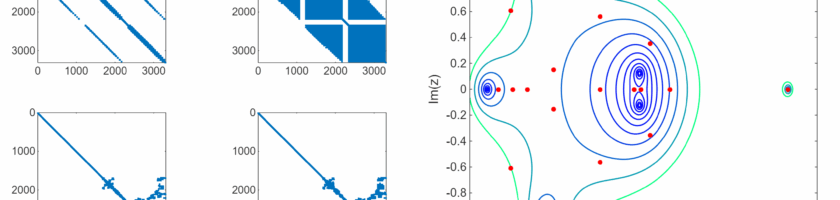
This series of lectures will introduce the theoretical and practical ideas for iterative methods applied to sparse matrices. Sparse matrices arise in many applications across science, engineering, statistics, business and beyond. Iterative methods that exploit the sparsity of these matrices are essential for overcoming the scaling on storage and floating-point calculations that otherwise renders problems even of modest dimensionality impractical to solve.

A remarkably versatile family of numerical methods called Krylov subspace methods can be applied to a wide class of sparse matrix problems. In doing so, they impose only minimal requirements on the means by which a matrix is utilised, paving the way for many of today’s high-performance codes. This course covers Krylov subspace methods for two common problems: eigenvalue problems and linear systems, from their derivation through to efficient numerical implementation.

The lectures will be running in zoom.

Join Zoom Meeting
https://qut.zoom.us/j/87221801096?pwd=TGQK2WysRMquyaohaNhK9FryY3X5MC.1

Meeting ID: 872 2180 1096
Passcode: 519836

The lecture recordings will be available via our YouTube channel.

We are looking forward to seeing you soon.

Nadia (nsukhorukova@swin.edu.au)

Monday lecture: slides and code (PDF format only).

Tuesday lecture: slides and code files (PDF format only): Arnoldi Convergence, Arnoldi Theory Check, Arnoldi VS Naive and Gram-Schmidt Comparison

Wednesday lecture: slides

Thursday lecture: slides

Friday lecture: slides
Head of Department & Associate Dean, Mathematics & Geospatial Science

  • This is an opportunity to join RMIT’s School of Science and be part of the leadership team contributing to the School’s academic and research performance, strategy, and growth as the Head of the newly formed Department of Mathematical and Geospatial Sciences.
  • The new school consist of approximately 50 academics as well as a number of research staff. The new school has several undergraduate and post graduate by course work programs and well as a thriving PhD program.
  • Remuneration for Academic Level E ($219,084) or Level D ($170,080 – $187,373) + leadership allowance + 17% Super
  • This role will be attractive to candidates seeking to develop, extend and apply their leadership skills to deliver excellence across research and education activities, working with a team of Deputy Department Heads within the new Department.
  • This 3-year Head of Department and Associate Dean appointment is underpinned by an ongoing Professor or Associate Professor role

External Applicants

https://rmit.wd3.myworkdayjobs.com/en-US/RMIT_Careers/job/Melbourne/Head-of-Department—Associate-Dean–Mathematics-and-Geospatial-Science_JR39971

AMSI-MATRIX 2025 Winter School on mathematics for action

AMSI-MATRIX Winter School is an annual two-week event designed for postgraduate students, early-career researchers and industry professionals in the mathematical sciences and related disciplines.

Mathematics for Action: Supporting Decision-Making for a Better Future. The program includes social events, specialist guest lectures, participants talks and a careers session to promote networking and collaboration. For the first time, AMSI has partnered with The University of Newcastle to lead the academic program and MATRIX to host the Winter School in Creswick, Victoria from 1-12 September.

For more information, please refer to

Home – Winter School 2024

Congratulations

Congratulations to Professor Jeya Jeyakumar, Prof. Guoyin Li and Ms Queenie Huang for receiving the best paper award by Euro Journal of Computational Maths (Marguerite Frank award).

https://www.unsw.edu.au/news/2025/04/unsw-mathematicians-win-marguerite-frank-award-for-best-ejco-paper-2024

The awarded paper, Piecewise SOS-convex moment optimization and applications via exact semi-definite programs, opens in a new window, examines exact Semi-Definite Program (SDP) reformulations for infinite-dimensional moment optimization problems involving a new class of piecewise Sum-of-Squares (SOS)-convex functions and projected spectrahedral support sets.

Congratulation from MoCaO!!!!!!!

WOMBAT 2024

The Discipline of Business Analytics at the University of Sydney is pleased to host WOMBAT (Workshop on Optimisation, Metric Bounds, Approximation and Transversality).

  • Dates: Wednesday 4th – Friday 6th December 2024
  • Venue: The University of Sydney Business School

The event will be entirely in-person.

For the first time, WOMBAT will run a summer school taught by Prof. Fred Roosta (University of Queensland). In addition, a keynote talk will be given by Prof. Melvyn Sim (National University of Singapore).

Registration is free to all participants and open until 25th October. We welcome abstract submissions for talks on all aspects of optimisation (broadly defined). Some travel support for students is available.

For more details (including the registration form), see the event website:

Organising committee:

Li Chen

Nam Ho-Nguyen

Dmytro Matsypura

Joint meeting of the NZMS, AustMS and AMS

Call for Abstracts in the Special Session “Optimisation”

Dear friends and colleagues,

The Joint Meeting of the New Zealand, Australian and American Mathematical Societies will take place from the 9th to the 13th of December 2024 at the University of Auckland, New Zealand. A website for the conference is available at:

It is our great pleasure to invite you to participate in the special session “Optimisation” and hope that you will agree to present a 25-minute talk.

This special session will focus on new mathematical and computational developments and their applications in all areas of continuous and discrete optimisation. Submissions related to applications of optimisation in data science, as well as data science applications in optimisation, are also welcome. We are delighted to have Defeng Sun (Hong Kong Polytechnic University) and Christiane Tammer (Martin-Luther-University Halle-Wittenberg) as our keynote speakers.

As the session will have a maximum of 25 speakers, please let us know your interest to present by October 18, 2024.

We welcome participation of Early Career Researchers and doctoral students in our special session. Speakers can submit abstracts for each session, and also register for the conference, through the registration link:

Please be advised that the cheaper Early Bird fees close on October 25, 2024.

We look forward to meeting you at the conference.

Best wishes,

Minh Dao, RMIT University

James Foster, CSIRO

Andrea Raith, University of Auckland

Matthew Tam, University of Melbourne

Golbon Zakeri, University of Massachusetts Amherst

(Session Organisers)

MOCAO lectures, July, 19

The last talk is tomorrow (11AM, AEST)

Speaker: Bruno F. Lourenço

—————

Title: Facial reduction and applications

—————-

Abstract:

Conic linear programs (CLPs) are a far-reaching generalization of classical linear programs. However, general CLPs may suffer from certain theoretical illnesses that make them significantly more challenging to solve in comparison to LPs. 

In this context, facial reduction, a technique originally developed by Borwein and Wolkowicz, can be used to improve the theoretical properties of CLPs and make them more manageable.

In this lecture, we will present a basic overview of facial reduction together with a few applications and recent developments. 

Zoom:

https://unsw.zoom.us/j/89239495027?pwd=zMmvAkAmFZVQ4SzBhQkz6CuH4nuxwu.1

Registration for urgent updates: https://forms.gle/CGhNt3bssmqLMXcj6

Looking forward to seeing you tomorrow.

Nadia

MOCAO lectures: A/Prof Vera Roshchina, UNSW

Lectures on Convex Geometry

A/Prof Vera Roshchina, UNSW.

Monday, July, 15-Wednesday, July, 17, 11AM each day (AEST)

We go over the basics of facial structure of convex sets, starting with the finite dimensional setting. We review the tools that help study geometric properties of convex sets and to construct convex sets with desirable properties. We then focus on structured convex problems, predominantly those defined algebraically (through matrix and polynomial inequalities and representations). Finally, we review some properties and behaviours of convex sets that are specific to the infinite-dimensional setting. The fundamental mathematical ideas and phenomena will be contextualised in optimisation applications, including conic programming and projection methods.

Zoom:

https://unsw.zoom.us/j/89239495027?pwd=zMmvAkAmFZVQ4SzBhQkz6CuH4nuxwu.1

Registration for urgent updates: https://forms.gle/CGhNt3bssmqLMXcj6

1 2 3 4 12